What it is, and what it is not
An executive summary slide is the opening page of a presentation that states the recommendation, the two or three reasons that support it, and the decision the audience has to make. It goes first, it is read first, and in a lot of rooms it is the only page that gets read properly at all.
That single sentence rules out most of what gets put on the page. It is not an agenda; an agenda tells the reader the order of the meeting. It is not a table of contents; that tells them which pages exist. It is not a scope or background page, and it is emphatically not a summary of the work you did. "We interviewed 40 customers, built a cost model and ran three scenarios" is a methodology page wearing the wrong title. Nobody approves a decision because you were busy.
The distinction to hold on to is between summarising the deck and summarising the conclusion. A summary of the deck says what each chapter contains; a summary of the conclusion says what should happen, why it holds, and what the reader has to do about it. Only the second is an executive summary.
Put your hand over the rest of the deck and read only this page. If the reader can now say what should happen, who owns it and by when; and could give the two or three reasons if challenged; you have an executive summary slide. If all they can say is what the document is about, you have a contents page with a better font.
Answer
Lead with the recommendation.
Support
Choose the evidence that matters.
Ask
Name the decision and next step.
The template collection
Six ways to tell the story.
Editable PowerPoint slides and downloadable PDF previews. Choose a layout, then make it your own.
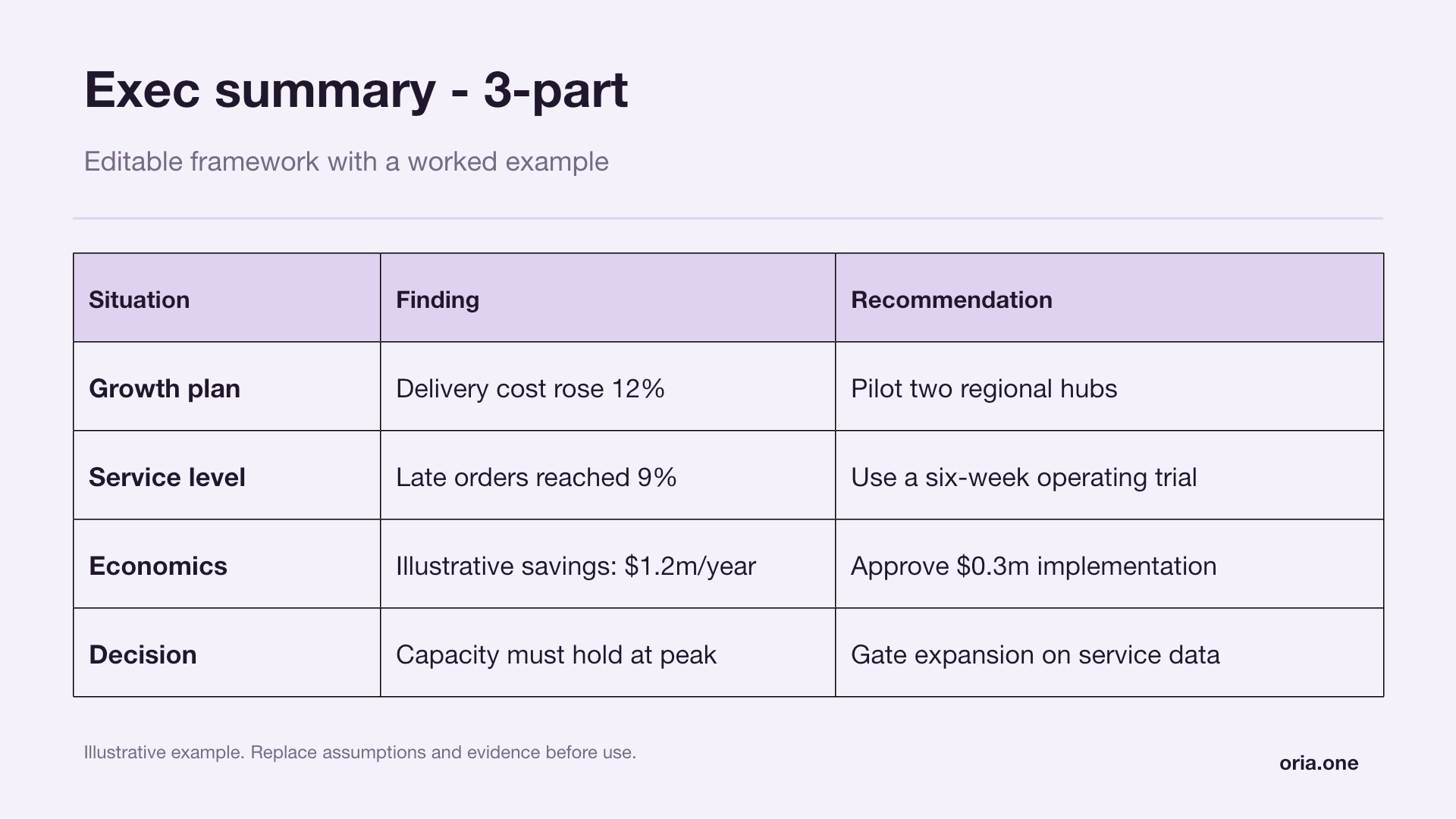
Exec summary - 3-partLilac editorial
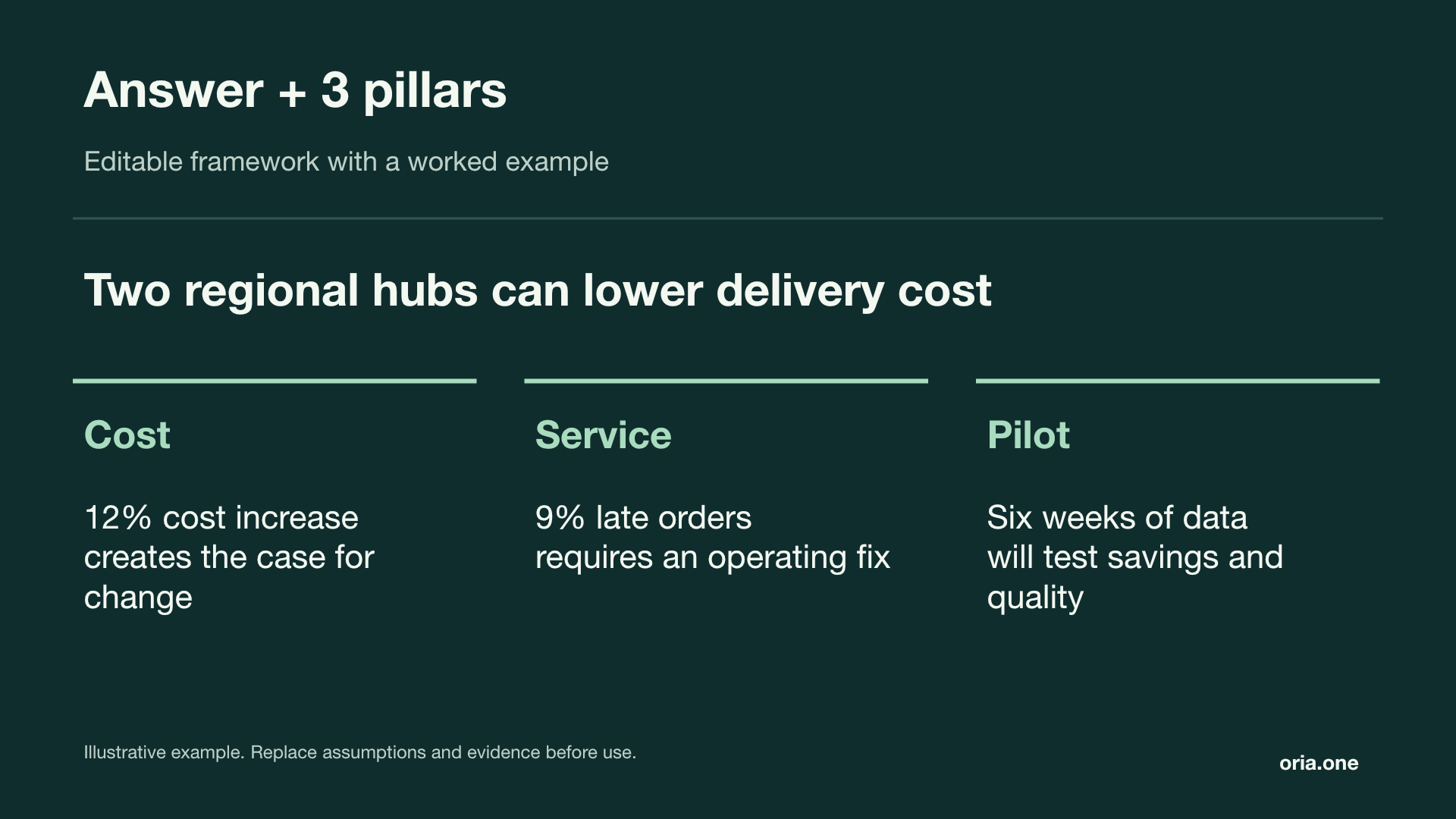
Answer + 3 pillarsMidnight mint
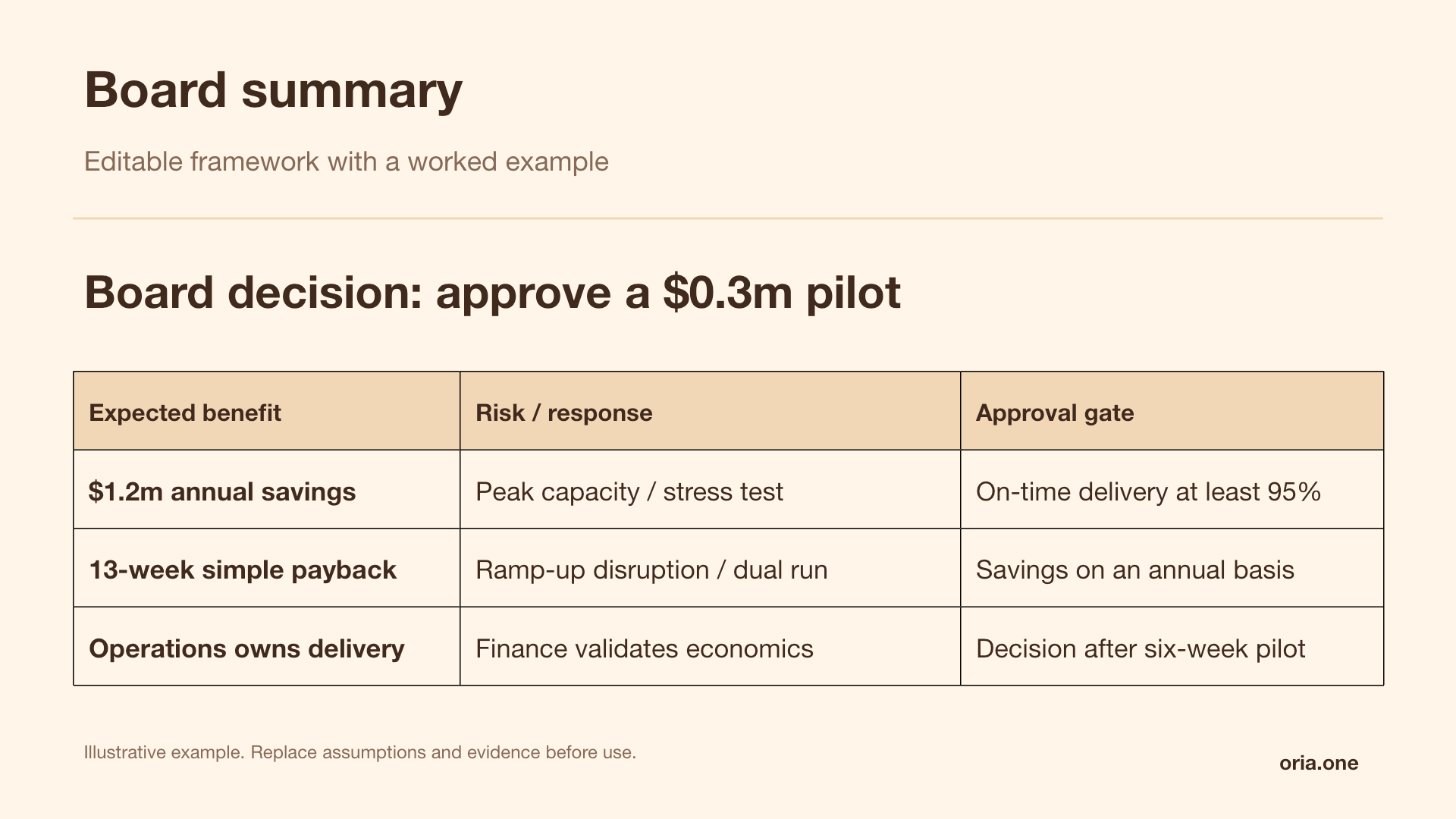
Board summaryWarm studio
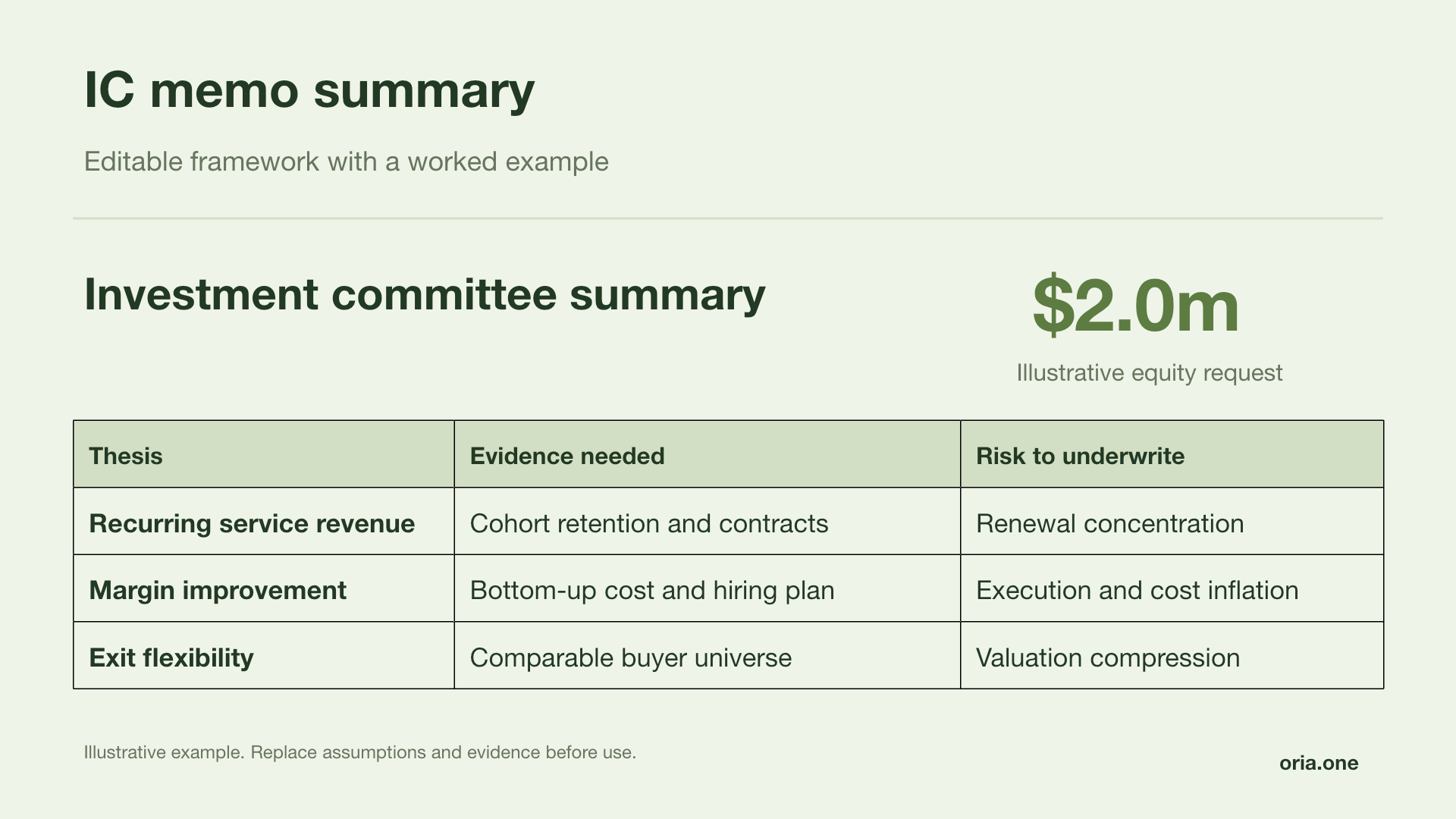
IC memo summaryForest report
Cost programme - workedBlue analysis
Market entry - workedGraphite orchid
Illustrative examples. All slide text and chart shapes are editable; replace sample values with your own analysis.
The three structures that actually work
There are only three shapes worth using. Which one you pick depends on whether the room already shares your framing of the problem.
1. Situation → key findings → recommendation
Use it when the reader does not yet share your framing, or when the situation has moved since the last meeting. The situation block is one or two lines and must contain the change ("volumes have held, but contribution margin has fallen 240 basis points since January"), never a history lesson. Findings are two to four, each carrying a number. The recommendation is a single sentence with a verb in it.
Example top line: "Margin, not demand, is the problem; three fixes recover most of the gap this financial year."
2. Answer + three pillars
The purest form, and the default when framing is agreed and a decision is live. The top line is the answer; beneath it sit three columns, each with an action title that is a complete assertion carrying its own evidence. The pillars are the reasons the answer holds; not three topics, not three workstreams, not three chapters.
Example top line: "Acquire rather than build: the same €45m reaches breakeven three years sooner."
3. So what / now what
Two blocks, used either as the closing strip of the structures above or on its own for a progress read where nothing new has been found but something still has to be decided. "So what" is the implication for the business; "now what" is the decision, the owner and the date. Steering committees live on this shape, and it is the block most often missing from summaries that feel informative but never move anything.
Example close: "So what: at the current run rate we land €34m short. Now what: approve the supplier mandate today; COO owns it; checked at the 15 November committee."
Anything more elaborate; a matrix, five pillars, a nested sub-structure; usually means the thinking has not converged. If you have five reasons, you have not yet found the two that make the other three unnecessary.
Anatomy: what sits where
A senior reader gives this page twenty to sixty seconds before deciding whether to argue with it. The eye moves top line → the three titles, left to right → the ask; everything else is read only if one of those four provokes a question. Build the page in that order.
- 1 · Context strip
- One line naming the decision in front of the room and the date it has to be made. Not history. If the group met last week, this line says what has changed since.
- 2 · Top line
- The governing sentence. Everything below it exists to defend it. It carries the recommendation and at least one number.
- 3–5 · Supporting pillars
- Two to four, three being the natural number. Each has an action title that asserts something, plus two or three lines or a small figure that proves it. They must not overlap: if two collapse into the same point under challenge, you had two reasons, not three.
- 6 · The ask
- Decision required, named owner, date, and the largest risk you are knowingly carrying. A summary with no owner and no date is a briefing, and briefings do not get approved.
Two rules follow from that reading path. The pillars run left to right in argument order, not in the order the workstreams happen to be numbered. And nothing on the page may depend on a later page to make sense; a summary that says "see p.14" for its main claim has moved the answer to p.14.
Writing the top line, and the titles under it
Most weak executive summary slides fail in the same place: the top line names a topic instead of taking a position. Compare these three attempts at the same page.
"Update on the cost reduction programme"
Tells the reader the subject. Commits to nothing. Could sit unchanged on the same deck for eleven months.
"The cost programme is progressing but faces some challenges in indirect spend"
"Some challenges" is a hedge. There is no number, so there is nothing to agree or disagree with, and no decision is implied.
"We can still hold the €120m target; but only by closing a €34m indirect gap, which needs two decisions today"
Position, quantum, condition, and an ask. A reader can now say yes, no or "prove the €34m", which is exactly what you want them to do.
Three tests. Is it falsifiable; could a well-informed person disagree? Does it contain a number; the quantum, the gap, the date, the return? Does it imply an action? A sentence that survives all three never begins with "Overview of" or "Update on".
Action titles: the discipline that carries the page
An action title asserts. "Market overview" is a label; "Poland is the only market of scale in the region without an incumbent above 8% share" is an action title. One sentence, one claim, and the number that proves it inside the sentence rather than left for the chart underneath to reveal. Fifteen words is a comfortable ceiling on a board page; beyond twenty a title stops being scannable and becomes body copy in a bold font.
The check that matters is the stack test: read the top line and the three action titles in order and ignore everything else. They should form a short paragraph that argues its own case. If they read as a list of headings, the titles are labels, and the page will not survive being forwarded to somebody who was not in the room; which is how most summaries actually get read.
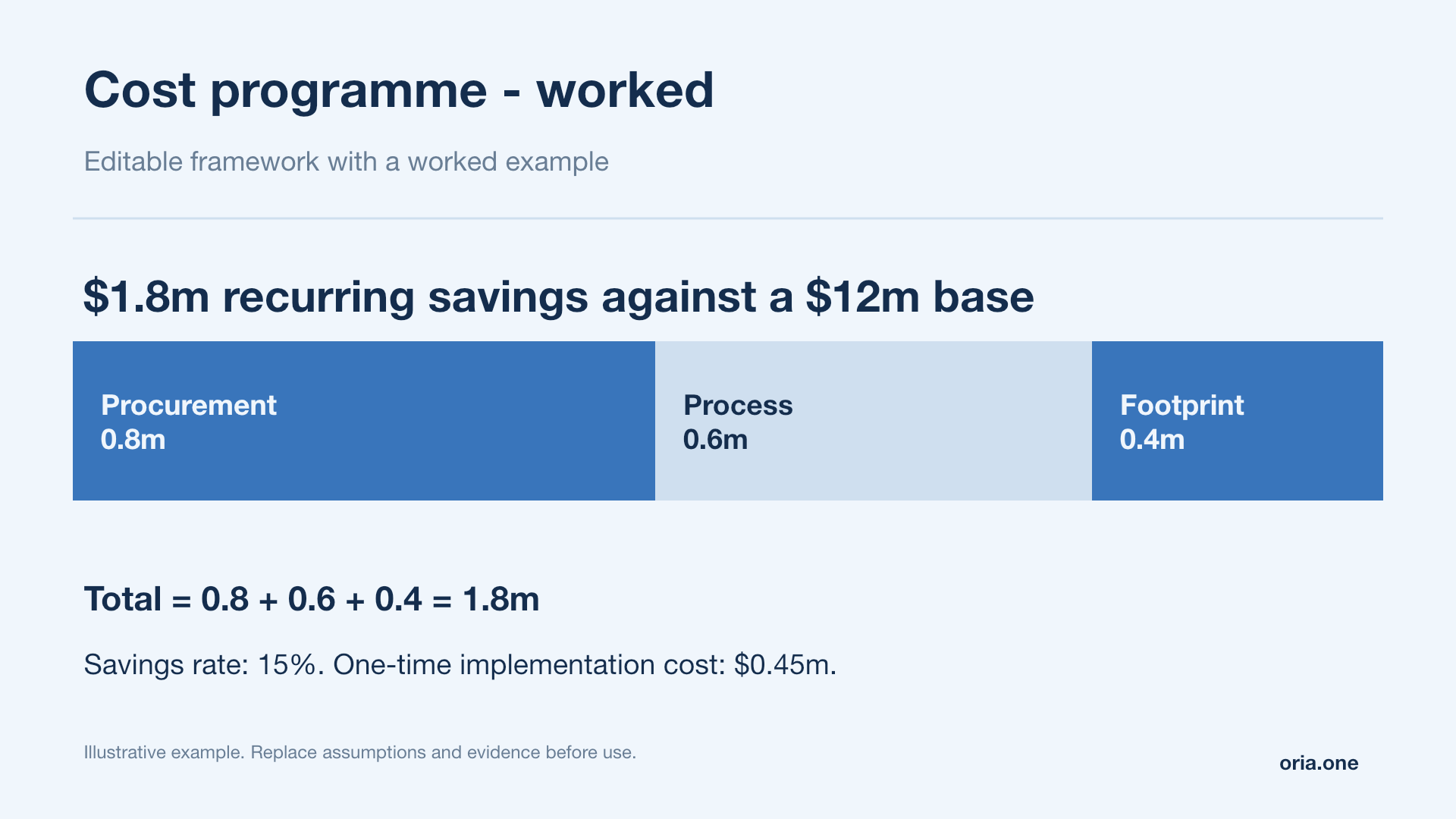
Worked example: a cost programme
Month four of a twelve-month programme at a European industrial manufacturer, presented to the steering committee. The company, the programme and every figure in it are invented for this guide; the point is the shape of the sentences, not the arithmetic.
Notice what the page does not contain: no timeline, no governance chart, no workstream list, no "achievements to date". Those are the pages behind it. Notice also that the three titles pass the stack test; most of the money is safe, the shortfall has one cause, two decisions fix it. That is the whole argument, and a reader who reads nothing else has it.
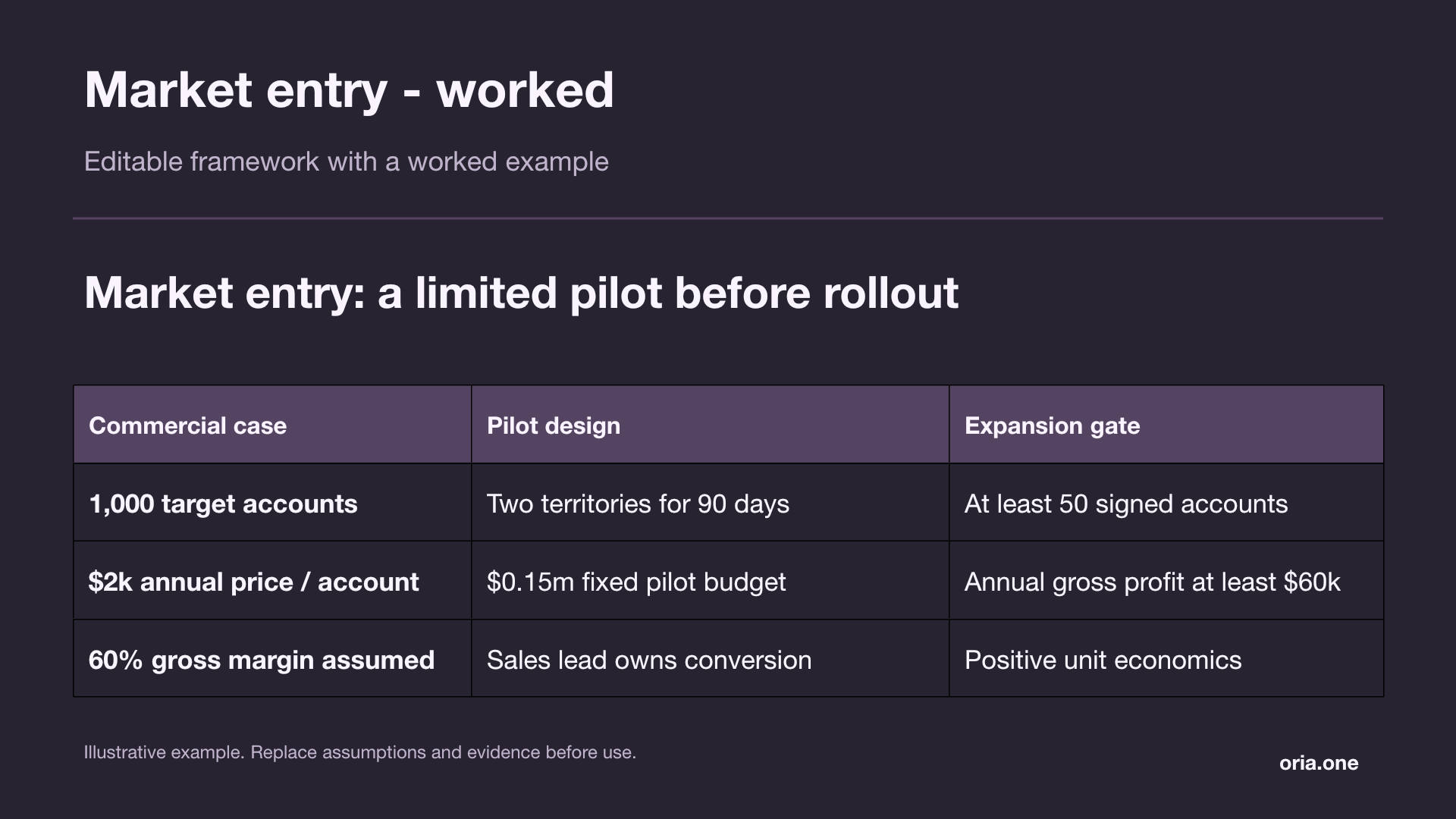
Worked example: a market entry
Same discipline, a different decision: a services group taking a market entry case to its investment committee. Again the company, the targets and all of the numbers are invented.
The second pillar does the real work here. The claim is not "acquire beats build" in the abstract; it is that the two options fail on different dimensions and the one that binds is time. Good executive summary slides usually carry exactly one insight of that kind, stated plainly; everything else on the page exists to stop somebody dismissing it.
How much belongs on one page
The working budget is one slide, 90 to 130 words, three pillars, and at most one small piece of quantification per pillar. If it will not fit, the problem is almost never the page size; it is that you are summarising three decisions at once, or you have not yet chosen between two reasons that say the same thing.
A two-page executive summary is legitimate in three situations. Board and regulatory packs read in advance, where there is no presenter and the page carries the reasoning alone. Transactions, where the summary must also carry price, structure, conditions and timetable, which do not compress. And multi-workstream programmes where each stream has a status the governance body is separately accountable for. Even then, the second page is a second slide with its own top line, never a continuation with the title chopped off.
The slide is not the written executive summary
They share a name and almost nothing else. A written executive summary in a report or memo runs one to two pages of continuous prose, carries no action titles, and must survive being read alone at half past ten at night with no presenter and no questions possible. The slide is read in a room with somebody standing next to it and can lean on the two hundred pages behind it. Converting one to the other by copy-and-paste produces the two commonest failures in corporate documents: a slide that is a wall of prose, and a memo that is a stack of fragments.
Management Summary: the same page under a different name
If you work with German, Austrian or Swiss colleagues you will meet this page as the Management Summary; an English phrase that sits inside otherwise German decks, and the standard label there rather than a translation of "executive summary". It is the same artifact: the answer up front, the reasons under it, the ask at the bottom. Nothing in this guide changes for it.
Two practical consequences. If you are building a deck for a DACH audience, use the heading they expect on the page itself rather than "Executive Summary", because the label is what tells a reader which page carries the decision. And if you are searching for templates or examples and finding thin results, search the other term; the same material is filed under both names, and the two vocabularies barely overlap. Elsewhere you will also see the page called key messages or simply the one-pager; those are the same page too.
How it changes by audience
The structure holds across rooms; the emphasis does not. What a board wants in the top line is not what an investment committee wants, and a client partner reviewing your draft is reading for something different again.
| Audience | What they are actually deciding | The top line must state | Evidence they will test | Typical failure |
|---|---|---|---|---|
| Board | Whether to back management's judgement, and whether they have been told the bad news | The recommendation, the size of the commitment, and the exposure if it goes wrong | Downside case, governance, what changed since the last meeting | Optimism with no risk line; reads as management managing the board |
| Investment committee | Whether to commit capital at this price on these terms | Amount, use of funds, return or breakeven, and the alternative you rejected | The base case bridge, the two or three assumptions that drive it, and diligence gaps | No stated alternative, so the committee cannot tell whether the option was chosen or defaulted into |
| Steering committee | Whether to unblock something, reallocate people, or accept a slip | Status against commitment, the gap, and the specific decisions needed today | Run rate versus plan, owners, dates, dependencies on other functions | An informative status page with no ask; the meeting ends with nothing decided |
| Client partner (internal review) | Whether the answer is defensible and whether the deck earns the answer | The single sharpest version of the recommendation, unhedged | Whether each action title is actually supported by the page behind it | Hedged language inserted to survive review, which drains the page of its position |
One cross-cutting rule: the more senior the room, the earlier the ask appears and the fewer the pillars. Boards routinely get two pillars and a risk line. Working sessions can carry four.
The failures that kill the page
- Hedging. "Broadly on track", "some challenges", "considerations around". Hedges are inserted to avoid being wrong and have the side effect of making the page unfalsifiable, which is the same as making it useless.
- No number in the top line. If the reader cannot tell how big the thing is, they cannot tell how much attention it deserves.
- Overlapping findings. Three points that turn out to be one point described three ways. Test each pair: can one be true and the other false? If not, merge them and find a genuine third.
- A recommendation with no owner and no date. The single most common reason a well-argued summary produces no action.
- Writing it first. A summary drafted before the analysis is a hypothesis that has quietly promoted itself to a conclusion; the rest of the work then becomes a search for support.
- Summarising the process. Interviews conducted, models built, workshops run. Effort is not evidence.
- Labels instead of action titles. "Market context", "Financial impact", "Next steps". The page becomes a contents list with a coat of paint.
- Burying the ask at the back. If the decision only appears on the final page, the room spends its energy on the middle of the deck and runs out of time exactly where it mattered.
- Repeating the summary at the end. If the closing page says something different from the opening one, one of them is wrong. If it says the same thing, it is a page.
The fastest self-edit is to read the page aloud to somebody who has not seen the work. If they interrupt with "so what do you want me to do?", the ask is buried. If they say "sounds sensible" and ask nothing, the position is too soft to be worth defending.
Common questions
Should the executive summary come before or after the agenda?
Before, always; and in most decks the agenda should not be its own page at all, because it trains the room to wait for the answer. If a running order is genuinely needed, put it as a slim strip on the summary page itself. The first thing on the screen should be the thing you want the room to argue with.
How long should an executive summary slide be?
One page, roughly 90 to 130 words, with two to four supporting points. Three is the natural number. Two pages are defensible for board packs read in advance, for transactions where the terms have to appear, and for multi-workstream programme governance; but the second page must be a proper slide with its own top line, not an overflow.
Should I write the executive summary slide first or last?
Last. You cannot summarise a conclusion you have not reached, and a summary written early becomes the thing the analysis is bent towards. What is worth doing early is a hypothesis version of the page, treated as something to disprove; it tells you which analysis matters and which is decoration. Then you throw it away and write the real one from the findings.
What is the difference between an executive summary and a management summary?
None in substance. Management Summary is the standard label in German-speaking business practice; an English phrase that lives inside otherwise German decks; for exactly the same page, with the same top line, the same supporting points and the same ask. Some organisations also use key messages or the one-pager. What changes is only the heading you print on the slide: use the term the room expects, because that label is what tells a reader which page carries the decision.
Can an executive summary slide have a chart on it?
One small one at most, and only if it is the evidence for a pillar rather than a chart that happens to be interesting. A single bridge, a two-bar comparison or a compact table under an action title works. A full-size exhibit does not: it pulls the eye off the top line, and a reader studying axis labels has stopped reading your argument.
What do I write when there is no recommendation yet?
State the position you can defend today and be explicit about what would change it. "On current evidence the acquisition route wins on time to breakeven; the case turns on installer retention, which diligence closes on 12 February" is a real summary. "Analysis ongoing" is not. If you genuinely cannot take any position, the honest summary is the decision the room must make about the work itself; more time, a narrower scope, or a stop.